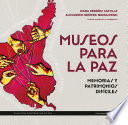
Alexander Herrera Wassilowsky, Diana Ordoñez Castillo
Explore with Alexander Herrera Wassilowsky and Diana Ordoñez Castillo how museums and memory practices, especially those emerging from the margins, build sustainable peace and social justice in Colombia.
Museums for Peace functions as a crucial platform that promotes and facilitates deep dialogues and critical reflections on the irreplaceable role that historical memory plays in the complex processes of lasting peacebuilding and in the persistent search for social justice and reparation within the Colombian context. To achieve this, the initiative proposes a horizontal conversation, where the plurality of voices and perspectives is valued, examining the intrinsic intertwining between long-term memories—that is, those transmitted across generations and forming part of intangible heritage—and contemporary practices of commemoration, mourning, and tribute that have emerged as a direct response to past violence and its persistent traumas. From this perspective, Museums for Peace assumes that diverse memory practices are not mere acts of remembering, but true forms of collective care and ethical resistance that, when cultivated, lay the necessary groundwork and foundations for the reaffirmation of the dignity of human life. The central hypothesis articulating the content of this book posits that the unique forms of experiential knowledge, the symbolic languages that emerge, the complex emotions expressed, and the alternative rationalities generated by memory initiatives arising from social and cultural margins—beyond official institutions or hegemonic "showcases"—represent paradigmatic and extremely powerful examples of how sustainable peace is built. Its twelve chapters offer an enriched synthesis of current theoretical and practical discussions on the significant aesthetic and political capacity of the repertoires and strategies that communities deploy to confront and process what are termed "difficult knowledge" and "uncomfortable heritage" derived from experiences of mass violence. The authors of the work delve into a broad spectrum of phenomena, from the most intimate manifestations of mourning and the commemoration of violent death, to the challenging and multifaceted processes of reconciliation. Their analysis critically problematizes the continuity of extractivist logics in the present and explores the intricate complexity of the appearances of what is remembered and the persistent absences that shape the experience of memory. These analyses are nourished and developed from interdisciplinary theoretical intersections that draw upon archaeology to trace the past, anthropology to understand cultural practices, history to contextualize events, psychology to address trauma and resilience, museology to rethink the exhibition of heritage, memory studies as a central field of research, transitional justice in its ethical and political dimensions, and peacebuilding as the ultimate horizon of social transformation. The empirical richness of the book is manifested in its diverse case studies, which are not limited exclusively to museums in their traditional conception, but encompass a vast range of spaces, practices, and mechanisms. These include, for example, judicial mechanisms as truth-seeking arenas, cemeteries and mass graves as sites of memory and mourning, bodies of water transformed into monuments, as well as artistic and cultural expressions like plays and songs that convey remembrance and resistance. Additionally, the book examines strategies implemented both by state initiatives seeking to promote memory from within institutional frameworks, and by a myriad of grassroots community organizations, social movements of various kinds, and specific youth and women's collectives, who, from their own realities and experiences, construct alternative and challenging memory narratives, thereby demonstrating the plural and contested nature of the field of memory in Colombia.
Authors: Alexander Herrera Wassilowsky, Diana Ordoñez Castillo
Publication date: 03-11-2025
Language: es
Pages: 289
Rating: No data
Museos para la paz, written by Alexander Herrera Wassilowsky, Diana Ordoñez Castillo and published on 03-11-2025, is included in our catalog for information queries and ebook downloads in epub or pdf format.
Use the search bar to find the book you want
 Español


